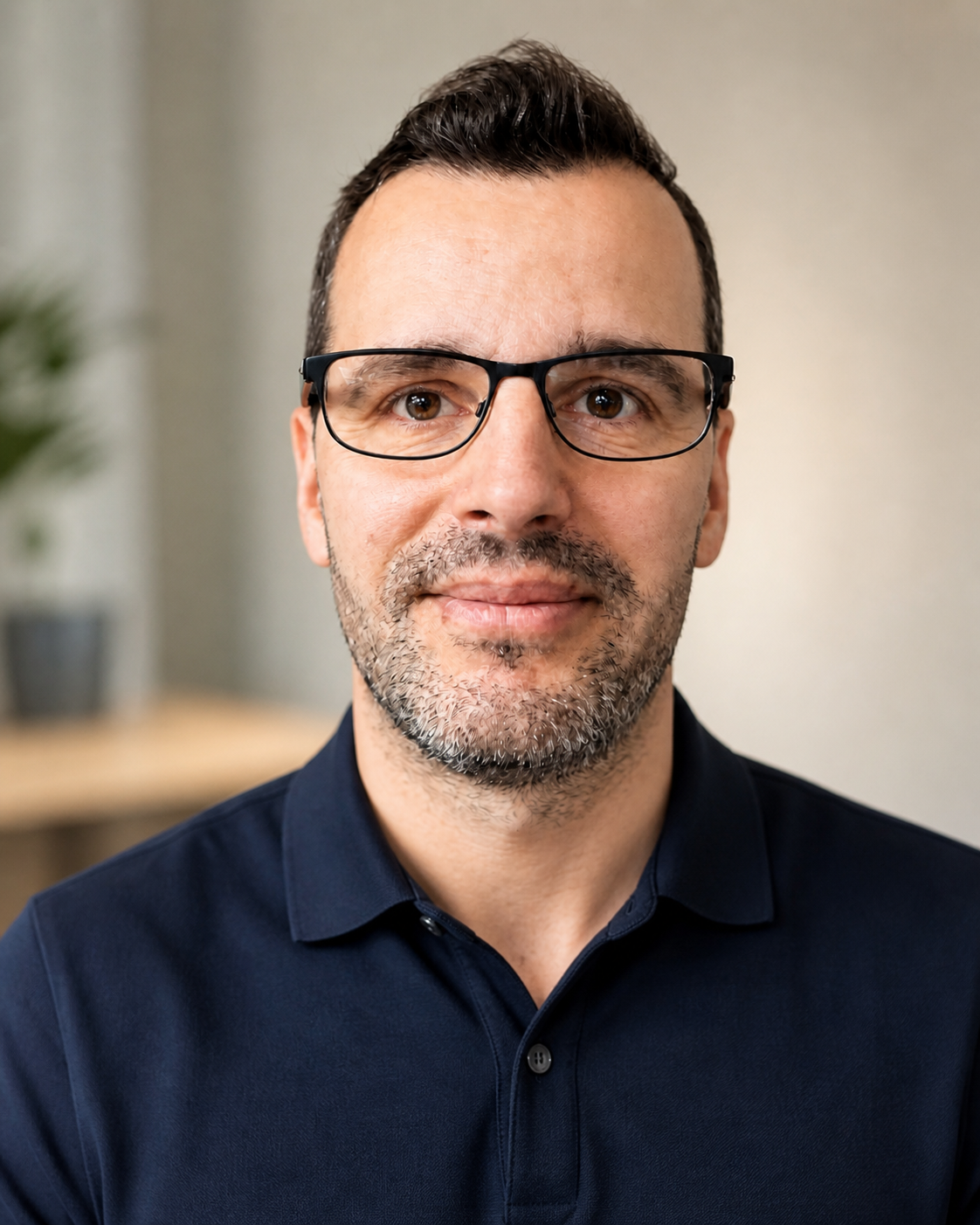
For over twenty years I have run companies, operations and technical projects. I now combine that experience with artificial intelligence — to help owners, directors and managers deploy it meaningfully, not just at the margins.
For over twenty years I have run companies and read their processes — I know where people lose time and where decisions are made by gut feeling. I deploy AI there deliberately, not across the board. I measure results in hours saved, not in the number of tools.
I go through your operation with you and identify the specific places where AI saves time, money or improves decision quality. No theory. With numbers.
→A roadmap for owners and directors. What to deploy first, where to be cautious, how to measure impact. Built on the real goals of the company.
→Practical rollout into operations — from tool selection, through data preparation, to integration with existing systems. You get a solution, not a PowerPoint.
→Hands-on training for employees — from the basics to advanced workflows. So that AI does not stay in the hands of a few enthusiasts, but is actually used.
→An intensive one- or two-day format for the management team. I show what AI can really do in 2026 — and what it cannot.
→Regular collaboration with the owner or director. A sparring partner who understands business reality and at the same time knows what is new and important in AI.
→
For over twenty years I have been leading teams, operations, technical projects and companies. I have worked my way through the roles of project manager, head of installations, director of strategy and development, commercial director, technical director and CEO. Contracts worth hundreds of millions, international teams, production and entire companies.
For the past three years I have been deeply involved in artificial intelligence — as a hobby that became a calling. I study tools, test workflows, read papers, follow the models. Not out of curiosity, but because I see how fast it is changing the way companies work.
My advantage is not that I can write a prompt. The advantage is that I understand what actually happens inside a company — where the bottlenecks are, where people lose time, where decisions are made on gut feeling instead of data. And that is where I know when AI makes sense and when it is just an expensive toy.
I have led companies, production and projects. I know what P&L responsibility means, what a hard deadline looks like and why processes break down. I am not a theorist who read a book about AI.
AI does not make sense everywhere. My job is to find the specific process steps where it makes real economic sense — and leave the rest alone.
With the owner I talk about ROI. With the foreman about the shift. With IT about integration. Translating between technology and business is half the success.
I follow AI every day, for three years. Not as a trend, but as a craft. I know what is possible today, what is coming in a year and what to avoid.
If something does not make sense, I say so. If something fails, I say that too. No PR, no buzzwords. The way I am used to from construction and production.
I work with sensitive data and processes. An NDA is a given. What I learn at a client stays with the client.
A short, no-obligation call. We talk about where the company stands, what is troubling you and whether it makes sense to go further. If we are not a good fit, I will say so straight.
Before we train anything, I take a close look at the company. I run short interviews with the owner, key people and selected employees. I map the processes and look for the places where AI delivers measurable time savings or higher output quality.
Output: A short audit document with a prioritised list of opportunities, recommended tools and follow-up steps. Without this step, training is done blind.
A series of shorter blocks in a small-group format (typically 3 hours in person, with 1–2 weeks between them). The emphasis is on practice, not theory — we work on the client's real tasks, not on generic examples. Between blocks, participants get homework, which we then evaluate together.
What is typically covered: the basics of working with language models, a comparison of tools (ChatGPT, Claude, Gemini, Copilot), writing effective prompts, client communication, marketing and content, internal processes and reporting. The exact mix always follows the audit output.
Here we move from using AI to adopting it. Together we build concrete agents that work for the company every day — automated reporting, a content generator, an assistant for client communication. We work primarily in the Claude environment (Projects, Skills, Claude Code, MCP connectors).
Goal: the company leaves not only with people who can operate AI, but also with a working infrastructure it can keep building on by itself.
We select specific processes and deploy AI on them. Measurably, with clear KPIs. A pilot is not a presentation — a pilot is something the team actually uses in the second month.
A month after the last workshop we meet over the results. We measure the real impact — how much time was saved, where the processes took hold and where they did not. We plan the continuation 6–12 months ahead (extending to another team, automating more processes, advanced topics).
Once the pilot works, we extend it to other areas. We train the team, set up governance and I keep you in the loop on what is new and worth trying.
A few lines about what you are dealing with is enough, and I will get back to you usually within 24 hours. The first 30-minute call is always no-obligation and free.
What the page sells: time saved thanks to AI, or „AI" as a product.